
Swedish odes
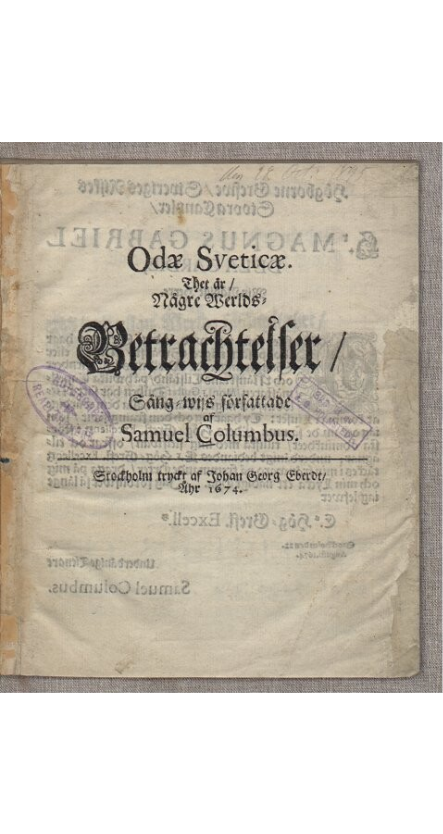
Translation of the psalm collection "Odæ Sveticæ" by Samuel Columbus

The transience of the world
God is good and good is all,
That His goodness has commanded.

1.
Our most high Lord God,
Who ev'rything good hath created,
By His gentle counsel,
In His mercy so pleased,
That all which is earthly,
What lies beneath the moon's ring,
Is understood, its essence is
An unchanging thing.

2.
Soon, the waters shall be still,
Soon, flood they shall,
O'er forests, fields, meadows and land;
Pretty houses and funny halls,
Soon shall they sink into the earth,
And hath there their course,
It springs to and fro,
Like the blood in the human body.

3.
Soon it shall raise itself high,
The plagued people shall call it
A fog, a cover, a cloud,
Soon shall it fall earthwards,
Then it shall be called rain.
If it's cold, it shall become ice and snow;
It shall be water as it was before
When it melts and becomes a thaw.

4.
Under such a domain
Is earth subordinated,
Soon is she soil and soon
Shall she become the grass and herbs,
Then it is torn up;
That which used to be earth
Becomes tendons, flesh and body.

5.
But as all water eventually
Returns to the sea;
So too doth all that is earthly
Return to the earth;
From the east, west and south
And from our frosty north;
So we want for the same goal
Be buried in the earth.

6.
It is not worthy of complain,
God's noble gifts granted to us,
Our youth's courage and pow'r
And the many fruitful harvests;
That they shall no longer appeal
And no longer bring joy.
Best we thus associate,
Then we have to leave.

7.
The rainbow's manifold is seen
When He paints the heav'ns,
Soon hath he wanished
And no longer with colours he swaggers;
Such happens too with our body,
He is a cultivated spec of dust;
Now he stands strong and upright,
Soon shall he fall apart.

8.
In splinter, hay and straws,
The flames of fire are easily birthed;
But see how soon
When it hath burned and its life ends;
That happens with our lives,
As if so covered forward;
Now it shines so bright,
Soon it will be extinguished.

9.
Alas! Heav'n, why must
Our lives be so short?
Why hath nature, for us, not
The life of a thousand years granted?
Of which we, the works of God
On earth must see,
All to the praise of the Lord Most High
And our pleasure.

10.
But how, alas! How I want
You, my God, to prescribe!
Do I want, with reason,
Step into your council's chamber?
Forgive me, great God,
Forgive me for my rashness.
We hath walked astray, but thou art
Wise with all your advice.

11.
With all my mind
I think of thine goodness,
And all of my comfort
I rely with my whole heart on thee.
If now a day of sorrow
Should take my body away,
A day of joy shall at last
Lead me back to him.

12.
For I will ne'er again
Surrender myself to sorrow,
But in life and death
I shall remain at peace.
If you call me now,
Well then, I am now ready;
If you wish for me to live,
My God, I am at peace.
The changing of the world portrayed through seafaring
II.

If you want to merrily sail
Must you also the storms withstand.
Then you may treasure thyself
If, with both, you are content.

1.
The wide and stormy sea
Is now calm and gentle.
But soon the storm brought
Caustic white froth,
Its waves peal loudly,
Its horrific roaring can be heard,
A vessel is pulled and torn,
And soon from its path is taken.

2.
To be on the world's open sea
Hath we been alloted by fate.
We sailed to and fro,
Between dat and night;
Wind, upwind, calm and stormy,
Change we shall achieve,
Many dangers
We may see.

3.
Many bountiful shores and lands
We see here and there,
To many-a lovely islands
We shall come ashore;
But the scathe! We do not
What kind of herbs we will find there,
Many sugar-sweet poisons
Destroy our minds and lives.

4.
If the sail is wholly unfurled
One rejoices in the good of misfortune:
Ev'ry wave raises
Our indigent spirits;
Soon, fortune feels foul
And courage hath said good night,
Despair, sorrow and resentment
Into the room hath itself rooted.

5.
Now it merily departs,
Now it follows the wind and waves;
It has happily here
Dined with his mind.
But soon the storm rises,
And soon hath the weather turned;
Often art thou driven
To where thou had not planned.

6.
Aye, that often happens, alas
It matters very little
That the ship bumps into something
And thusly it sinks.
One sails between two skerries
And is cast into the depths;
One sets out for land
And finds their grave in the sea.

7.
Blessed is he who can
Wisely follow the wind,
And when it blows strongly
The sails take it in,
Sand dunes, cliffs cuts,
They look all too dangerous.
And when he hath stranded,
He should wait with patience.

8.
Aye, may it follow
The right sail pin,
The true star's light,
Despite that the ocean's blue waves
Push and pull;
He shall, after the dangers,
At last find his peaceful harbour.

9.
Ye great God, who hath
Created the world and us,
Thou art our great God
And our comfort and coxswain;
The sweet gentle wind
Moves our hearts;
Then we arrive to thee
Well and rightous.
Virtue is everyone’s righteous cultivation
III.
Virtue and learning
Brings
Comfort and honour.

1.
O, how well is the soul
Who, for righteous virtues, sacrifices wit and reason,
And clings onto it, whate'er may happen,
If need—aye, death—
Comes, she stands,
Her gentle sun of rays she will see.

2.
Hath God anointed thee with wit.
Let us see in word and deed that it was not in vain granted;
To benefit whoever you can, let it though not be lead,
For gold in the earth,
Though unseen,
Is judged by the song to be of equal worth.

3.
If thou hath good hands
To work in good use, do for thee and others well!
For makes it not less glorious or virtuous,
Better to have than to take,
Better to understand than to possess:
A dragon is not worth the treasure he lies upon.

4.
Waves pushes waves; moment follows the other moment;
Our wandering step is different from the other.
Do not neglect the good once have obtained the pow'r,
When you now
Hath reached your limit,
Shall you never tread the path you once hath walked.
The vanity of the world
IV.
Is it vain and  little worth;
Who now holds it dear?

1.
What is the essence of the world?
A shadow, which, though without a body, resembles the body.
Its beauty? Glittering on the outside, smooth on the inside.
The beautiful corner of the eye has a constantly gnawing worm.
Its majesty? A lightening, which shines brightly in the blue skies;
But soon you see,
That he is beaten,
Its glamour you no longer see.

2.
But what is human life?
A dream; much is felt, but nothing is.
Its colours? A rainbow that graciously swaggers;
But its essence is the light reflecting of the waters.
Its fortune? A cartwheel, whic makes us spin about;
But just as soon we turn
And then we fall down.

3.
What is then our duty?
A cakewalk, which sounds loudly, itself is nothing worth.
Our desire? A shaking oak leaf
Which never stays still, until it fades
And finally falls off.
Great property? Small childish works, whose slightest margin we do enjoy:
But if things goes awry,
Of our courage are we deprived.
Song of comfort
V.
The whole world's frivolity,
Of pious sorrow is it not worthy.

1.
Join in, ye singers,
Sing a mourning song.
A woeful tone resounds
The complaint to heav'n of my errors.
That I shed heavy tears,
That I eat the bread of mourners,
No one comforts me in my distress.
Only God alone piques me.

2.
In myself I see, with sorrow,
Only sin and infirmity.
From my neighbour I must endure
malicious slander and every kind of vexation.
That which helps me happens seldom,
That which hurts me happens often.
An unfavourable view brings happiness,
Wherever I may turn.

3,
Shall I then surrender myself?
Shall I see myself as forsaken?
Shall sorrow become my lord?
Shall I let myself be ridiculed by my adversary?
Dear God, let me then feel
My dear Father's beating heart
In the midst of my sorrow and lament.
Therefore I want to turn to Thee.

4.
If I am consumed
By sin and infirmity,
Then I am, by thy grace, cleansed
Through thine Son's virginity.
That which I need, He grants to me,
That he knows the best.
He forgives my weakness,
and He alone deserves all the glory for His goodness.

5.
If the world wants to strive against me,
In my God shall I find peace.
If I endure sorrow and lament,
It will not last forever.
If I am not treated badly by my neighbour,
I will not harp on it.
Great God, I believe in Thee,
Thou make ev'rything better.

6.
After the heaviest rain and thickest fog,
After the sky dark nights,
The sun tends to shine clearly
And the air feels clear.
After the storm comes the calm,
After night comes the day,
After winter comes the spring,
After sorrow comes comfort and joy.

7.
Even if joy seems adverse,
Shall I, my soul, keep thee at pace,
Nothing good is perfect,
No one is wholy happy.
Something is always missing,
But in the mind's fairness
And the body's well-being
Exists still a perfect joy.

8.
Have I no pouches filled with gold,
Nothing so splendid, gorgeous and good?
I have good and a mind at ease,
So I hold to my heart
All that God graciously grants to me.
In his grace delight
All becomes my joy and for.

9.
Join in, ye singers,
Sing a mourning song.
I good mood do I find ingenuousness
And thank God for my part.
I hath shed heavy tears,
I hath eaten the bread of mourners;
That is my comfort unto death:
God heals he whom He wounds.
The price of love
VI.
Which heav'nly pow'r is it that awakes
Ev'ry noble mind, soul and body,
To rejoice and fall in love
With all that is good and gorgeous?

1.
All things living and life's source—
I mean thee, O pure love;
How can I possibly sing thine praises?
Your greatest praise is also thine purpose:
A heav'nly tongue should be granted to me,
So I can sing, worthwhile, praises of thee.

2.
When a unformed, horrible lot existed—
Aye, when nothing else yet had existed—
God himself created, with an abundance of love,
The entire world;
From God eminated love,
And to God should it be returned.

3.
Who is it that can still block thee in thy path?
How is thy strength so great?
Earth, heaven water thou hath united
So life would appear where there was none;
In fire, thou hath thine home—
Thou art present in the world from beginning to the end.

4.
Without thee is ev'rything silent,
Cold, dark and dead;
But with thee is ev'rything, in lovely longing,
Filled with joy, beautiful and as if they had rebirthed;
Like the compass for ev'ry sailor
Art thou the goal for all of natur.

5.
A clock will stop
When it loses it momentum;
Same rule applies to our function
When it is not driven by love.
Thus our lives are a feeble death,
Our mind is a dream, we ourselves are sleep.

6.
Thou art He who has enobled the noble heart,
Their lowly thoughts art thine soot;
Without thee, they speak savagely of thee;
But ne'er do they tread carefully.
Thou art the drive in our blood,
Thou strenghten our courage.

7.
To virtue and honour thou compelled us,
When the heart recieves thine gifts.
With dilligence and zeal we labour then
And follow thine advice.
All difficulties, you make it as easy as hay,
until we achieve our goal.

8.
To art and wisdom thou call us,
With an admirable taste;
To great thing thou bend thine mind,
with an irresistible harmony.
Where thou hath taken root,
Ye do not see ignorance nor savagery.

9.
To joy thou bend our minds,
Which is indeed the highest good;
Thou put an end to all the gnawing of the heart,
Which otherwise plagues the mind.
Thou art the world's strong bond,
Which ties together people and land.

10.
Solicitude is learned from thee,
Advice is thine sweet acolyte;
Experience grows from thee,
And judgement improves day by day,
Until this remains as the truth:
Evils flee, the good remains.

11.
Beauty soon loses its value,
The glance of the eyes soon fades away;
Gifts soon means nothing—
But if love gets even a little bit of room,
It strikes through like thunder and lighting,
And its pow'rs are felt instantly.

12.
It compells people to meet
Each other with hearty and friendly civility;
It keeps friends loyal to each other
In moments of greatest loveliness.
Harsh words and evil conscience
Thou leave to the people of the cold and the dark.

13.
All sorrows you doth trump,
In you there is comfort.
The bitter you make lovely for us,
Until our final breath.
You cool the burning hearts
And grants tranquility in the soul's distress.

14.
He who hath thine blood abadonned
Hath a life worse than death;
Thou hath driven away evil from him—
And even turned lust to virtue.
He becomes his own plague,
his world a cloud hanging o'er him.

15.
Putrefaction you defy fore'er,
Thine victories remains;
What time and age destroys,
You bring back to life.
All things earthly returns to the earth,
But love resurrects.

16.
When I think about it,
A realization strikes my heart:
That there is nothing good in the world
That can not be abused.
The more treasured something is,
The more severe the abuse of it is.

17.
In the sun is the fire purer,
On earth is it mixed with soil;
From God, who is the embodiment of love,
It shines clear—
But in a sinful heart is it distorted.
But, if reason is allowed to counsel us,
Love shall be eternally ours.

18.
Let us therefore love ev'ry honest soul,
Ev'rything that is beautiful good and honourable;
Hat, jealously, evil and sorrow disapears,
Which otherwise consumes blood and courage.
May our hearts come to realise
that ours is a golden age.
The price of marriage
VII.
The loveliness of a faithful friendship
Can to hardly anything be compared,
But if it exists in marriage—
What a heartily and lovely heart-bond.

1.
How vain is it
What the human heart eagerly pursues;
Yet fortune overturns
Everything the mind clings to.
A faithful friend and an entertained mind
Is my greatest treasure

2.
A royal spire can be transformed
Into a simple cane;
Greed has no end
Unless it is put to rest.
A faithful friend and an entertained mind
Is my greatest honour.

3.
Golden chains art bought to a great price,
The fool is madea slave to mammon;
Joy quickly passes by
Like lightning—great but brief.
A faithful friend and an entertained mind
Is my greatest joy.

4.
The works of art that nature doth create
Is a apparent apple of the eye;
It must make way for time
And leave the heart hardly satisfied.
A faithful friend and an entertained mind
Will time ne'er take from my mind.

5.
When I let my mind wander
To take in what reason can see,
All that the world tempting shows
What the world attractively displays
Ff all its trappings and empty knick-knacks:
A faithful friend and an entertained mind
Is still my greatest joy.

6.
When I let my mind wander more,
To where my treasure is obvious,
On the ocean of doubt, among many waves,
The heavens itself takes the wheel
And leads me to the safe shore—
The honourable marriage.

7.
The I will build my house steadfast
On the foundations of virtue and faithfulness,
Safe against all assaults of hauteur
And I do not care of the people's figments,
Nor envy's evil land—
For I value my marriage.

8.
If I am not rich on golden lumps,
Like Pactolus golden sands,
Then the heav'ns will adorn me with mercy
And give me my part in peace.
Great joy is like golden sand—
For I value my marriage.

9.
All of nature, I doth profess,
None shall live in solitude.
The smallest bird too shall have a mate,
whom it cherishes above all others.
All that lives and have a soul
Cherish with my the bond of marriage.

10.
If clouds of sorrow loom above me
(For joy is not always clear)
It will be dispelled by the sun,
God willing, and it will be over.
During that time will he comfort me
Through my marriage.

11.
The wild pansy, red by the mem'ry of love,
Turns itself to the sun;
So will I too, with an honest mind,
Go to meet my friend.
A good heart is just that bond
Which makes a good wedlock.

12.
What a joy it is when love runs wild!
He who tries to reign shall himself become a slave,
When, in the bodies of two mates,
An internally united soul lives.
One is the other's right hand—
O heav'nly, sweet wedlock!

13.
Alas, that you can't wish
That the cruel death would disappear.
But forever shall it be ripe,
My friend, my free will.
Thus triumphs, o'er thine strength,
A faithful friend and an entertained mind.
Ode to reason and will
(Can be sung to the first or second melody)
1.
Much, much good
Hath God, to us, granted
And hath shown us the right way to use it
Through our reason;
Reason is like a seed
That grows through knowledge;
And thereto doth experience
Give us new knowledge daily.

2.
Now reason hath taught us
To separate evil from good,
And our good God hath given us free will:
To reject evil,
To seek the good,
and thus increase God’s gift of grace
through our own diligence.

3.
But alas! There is a tendency
that leads us to believe all manner of delusions,
Following lust
Which also misleads our wills.
That have you not, our God, created—
That has the fiend sown
When man went astray
From thine message's frontiers.

4.
With these have thus
Man also struggled,
Until either he trumps
Or stifles him.
If he prevails, he shall have a gift—
A devout reward in his heart,
A gift that grants
Ev'rything that man asks and wishes for.

5.
But ye lordly people,
Who talk with a your mouth wide
And mimic good advice so mindlessly;
There will come a day
Where you will all be justly judged,
Then ev'ryone of thee will see;
God is no laughing matter
Reflections on a natural death
1.
What help is it that I torture my mind,
Selling my noble freedoms for, a vain profit?
Head, hand and lip strive in vain;
I torture myself, torture myself stubbornly—
Yet it will make all my labours meaningless
With a single snap of the finger.

2.
When I have left the humanity fraternity,
I am as though I hath never existed.
I am ushured into the long silence.
A long night hath torn my bones and loins,
A long night hath stiched together
My eyes, feets and hands.

3.
While a people see the light of the sun,
Another people tramples upon my sanctuary.
Alas, that I should become dust, without feelings!
I hath triumphed, my wander reaches at last an end.

4.
Why should I then worry for others
If they travel o'er oceans and fire and get taken to task,
When a inevitable death waits me?
Should I put myself in sorrow and worry?
What else would it do but to make my life
Unnecessarily difficult?

5.
Step forth, freedom, in thine unadulterated dress!
Come forth and break my yoke into a thousand pieces!
My yoke, made out of wood, is heavy and cumbrous;
The yoke that I willingly did put on myself
When I, in ignorance, saith to the shadows:
"Thou art dear to me."

6.
I hath now gotten to know that internal world,
How vain ev'rything is that we chase after,
And now fourtune lays traps for us.
God granted that I'd wander the world with dignity.
Often is great toil for ev'rything else
Not worth anything.

7.
God granted that I'd have the things I need
For a healthy mind, until I close my eyes;
It is and will remain the only thing that doth suffice.
He who wants more, he also searches more;
Of all the frivolties of the world
I hath chosen the least.
Evening song
(See footnote regarding title)1
In God's grace
Hath this day
Reached its end,
And night, sleep's friend,
Hath once again
Usurped the candle's trone.

2.
Thou great heav'nly pow'r,
Whom hath the shades of earth
With thine heav'nly lights
Changed in a wonderful way,
Art thyself unchanging—
Ne'er cower from us.

3.
Our eyes closes;
A heav'nly angel
You may send;
Who faithfully guards
And steadfastly surrounds
Our sanctuary.

4.
My clothes are taken off,
But my sins, O lord, are burrowed
Into Christ's wounds;
Then my infirmity
Shall be made into blazonry
When I rise from the earth.

5.
How heartily shall I then,
Pure from all sins,
In a shining garb,
Sing praises of thee,
You, even when I wallowed in sin,
Who was merciful God to me.
Here you can listen to the songs set to melodies. Note that not every verse is included in the recordings.
https://youtube.com/playlist?list=OLAK5uy_lE5hsYzeTSD3G-FNXPDH0WLv17q1MsFjE&si=Uj3HBD61fR5oeicF
1
This psalm goes under multiple titles through history. For example, the psalm has the title “Now hath this day” in the 1695 psalm book or just “evening” in the 1986 psalm book